Model-based development and validation of suspension, steering and chassis control systems
Driven by the development of automated driving functions, demands for driving safety and ride comfort are constantly rising. For this, powerful and, above all, safe chassis components and systems are needed. The related high development effort as well as the vast amount of required test scenarios help define the best setup for chassis, steering and control systems and contribute to the individual optimization of ride comfort and driving experience. The solutions from IPG Automotive support the efficient development of systems applicable to vehicle dynamics throughout the entire process.
Virtual prototypes
and scenario generation

- Reduce the number of physical prototypes by optimizing vehicle dynamics early on
- Precise full-vehicle model with detailed mapping of steering, brake, tire and aerodynamics
- Integration of control systems (e.g. ESC, steering and damper control, driver modes) in MIL, SIL and HIL environments
- Diverse scenarios and test variants for maximum test coverage
- Preconfigured road sections and scenarios result in low implementation effort

- Open integration and test platform for flexible and efficient development of steering and chassis systems across all development stages (MIL, SIL, HIL)
- Direct integration of customer-specific models, e.g. via FMU/FMI, C code or Simulink
- Consistent parameterization and versioning of models (e.g. chassis, tires, control algorithms) with complete traceability on measurement data and vehicle designs
- Support of various standards and interfaces for seamless integration into existing tool landscapes

- Reproducible tests under variable conditions support fast, safe and cost-efficient releases
- Early software tests with a high number of tests and millions of virtual kilometers for broad test coverage
- Real-time tests with physical ECU hardware on the virtual prototype to validate control systems and sensor technology
- Fast tuning of steering, dampening, roll and pitch behavior as well as vehicle dynamics for ride comfort

- Safe examination of critical driving maneuvers and physical limits without putting drivers or vehicles at risk
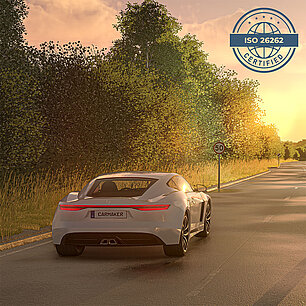
- Scenario-based validation with predefined use cases (e.g. ESC homologation maneuvers) to validate relevant operational design domains
- Consistent models and test criteria ensure a reliable, holistic analysis and validation of test results across all development stages
Use cases
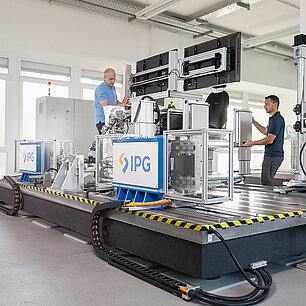
Real tire measurement in a virtual test drive: HIL coupling of GRIPS and TruckMaker
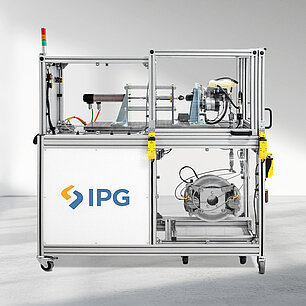
The new GRIPS tire test bench at the Karlsruhe Institute of Technology (KIT) combines real measurements with vehicle dynamics simulation. Drive, braking and steering processes are generated virtually and reproduced on the real-life tire via a hardware-in-the-loop coupling with TruckMaker. The forces and torques measured are immediately fed back into the simulation, allowing the analysis of tire behavior under realistic conditions, and the improvement of specific aspects of vehicle dynamics, efficiency and emissions.

Real-time capable physical tire models for realistic HIL tests in ECU development
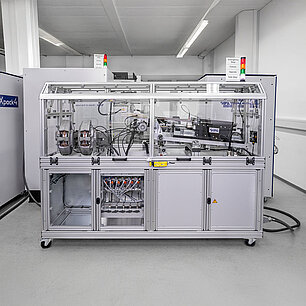
Hardware-in-the-loop (HIL) is an integral part of control unit development. Traditionally, this has been based on simple, empirical tire models. While these provide fast calculation, they are unable to deal with exceptional driving situations. With a real-time capable physical tire model, complex scenarios such as ABS braking on uneven surfaces or sudden loss of tire pressure can be simulated, and control units can be tested under more realistic conditions.

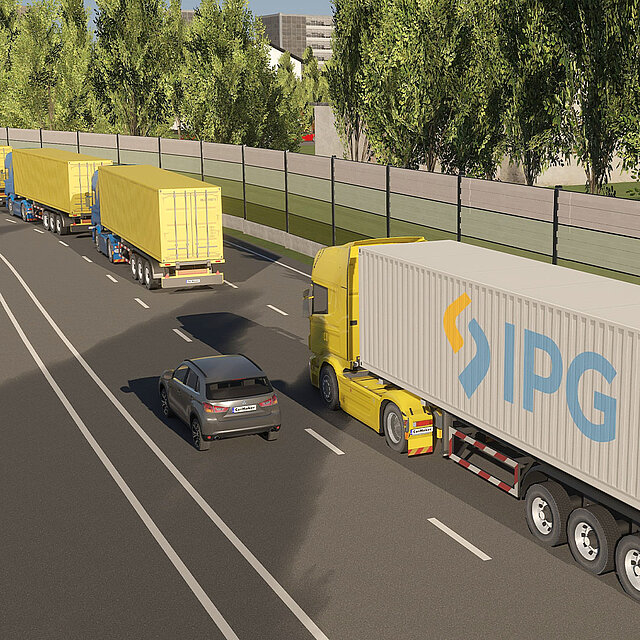
Platooning in road freight transport: V2V communication for validating a model-predictive control concept
As road freight transport continues to increase, energy consumption and traffic density are rising. Platooning can improve safety and reduce fuel consumption by efficiently controlling the distance between vehicles. An intelligent control concept combines model-predictive control with vehicle-to-vehicle communication. Co-simulations with TruckMaker and a real-time capable driving simulator enable validation under realistic conditions.