
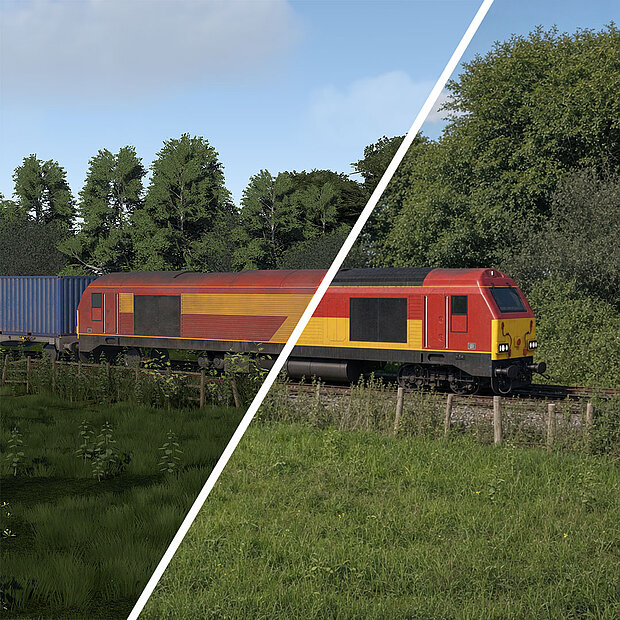
From simulation to the tracks
The requirements in rail transportation are diverse: from automation to driverless operation, from safety standards to the operation of networked systems – they significantly increase the complexity of system development. In addition, real-world test driving is time-consuming, difficult to replicate and can only be varied to a limited extent.
With our simulation-based test platform, you can test any scenario in the virtual world long before the first test run takes place on the tracks. The platform supports open-loop approaches as well as complete closed-loop simulations. This allows for early, flexible and cost-efficient validation of safety-critical functions and the interaction of complex subsystems.
Which area are you interested in?
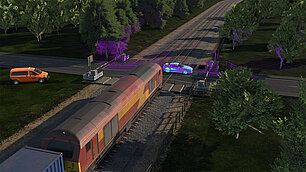
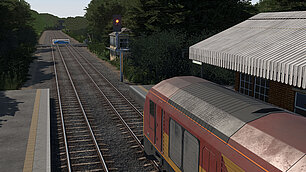
Automatic train operation
Challenges in development
- Sensor technology must reliably locate and detect surroundings under changing environmental conditions
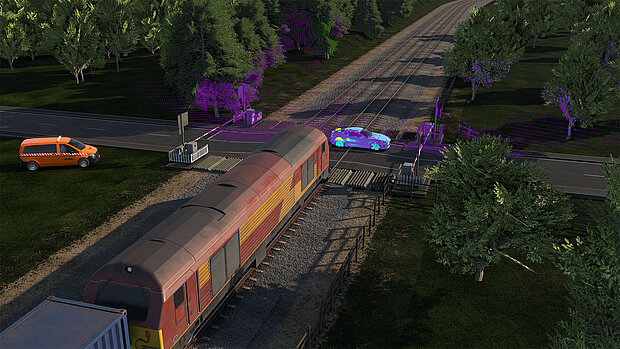
- Especially in urban environments, e.g. with streetcars, automated driving must manage highly complex interactions with numerous other road users
- Rare and safety-critical situations are almost impossible to reproduce in real-world operations
- The combination of recorded real-world sensor data and fully virtual models requires flexible test methods
How we can help
- Virtual sensor and environmental models for cameras, radar and lidar under various conditions
- Simulation of fully driverless operating scenarios in a closed control loop
- Virtual validation of complex urban interactions between streetcars, pedestrians and vehicles using a scenario-based test method
- Validation of complex software functions by flexibly switching between open-loop data analysis and closed-loop testing
Driver assistance and train control systems
How we can help
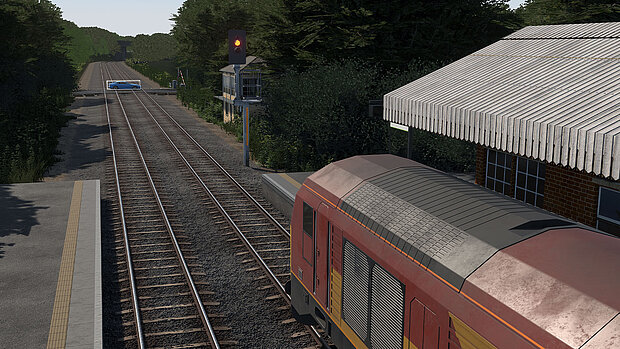
- Simulation of driver-specific assistance scenarios using realistic route models, both in open-loop replay and in interactive closed-loop tests
- Virtual test environment to validate interoperability without relying on real-world track infrastructure
- Modeling predictive infrastructure scenarios, such as wireless communication between railroad crossing cameras and trains
- Automated test execution to precisely calibrate autonomous braking commands based on external infrastructure data
Challenges in development
- Assistance functions for traffic sign and signal recognition must accurately interpret visual information, even with poor visibility, dirt buildup and at high speeds
- Modern railroad signaling requires accurate communication between the infrastructure on the track and the vehicle
- Critical events, such as obstacles at railroad crossings, must be reported by connected systems well before they come into the train's field of vision
- Interventions in brake and control systems require precise coordination between vehicle response and external signals
Virtual train and subsystem integration
Challenges in development
- High level of complexity involved in integrating the various vehicle subsystems into one functioning unit
- Interface conflicts between the various control units are often discovered very late during initial train operation
- Testing of railroad signaling and control software is often an issue because specific subsystems or the appropriate track infrastructure are not physically available during early stages of development
- Difficulty to test the interaction between software models and physical hardware continuously across different development stages
How we can help
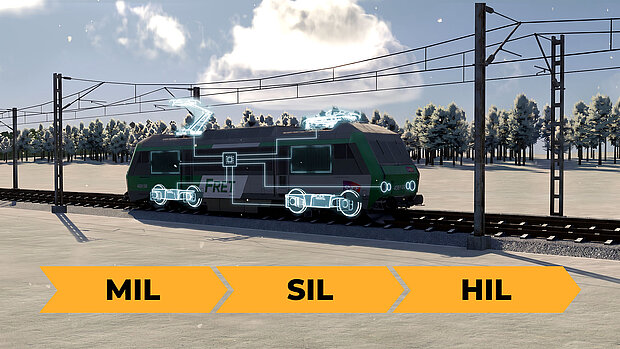
- Open test environment which allows you to integrate your own rail vehicle and component models, regardless of the manufacturer
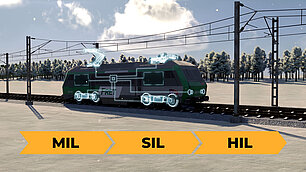
- End-to-end validation across the entire test chain, from model-in-the-loop (MIL) and software-in-the-loop (SIL) to hardware-in-the-loop (HIL)
- Early detection of interface risks by importing real-world log data into the virtual integration environment
- Connection of the simulation environment with real test benches via standardized interfaces for flexible validation of physical hardware components