
From early testing to continuous integration: Three factors that determine efficient development
June 9, 2026 | Alexander Frings | 5 min

Why does more testing earlier in the process not automatically lead to faster projects or lower costs? In automotive development, the promise of shift left, moving validation activities to earlier stages, has become a widely accepted paradigm. Yet, in practice, many organizations experience the opposite effect as complexity increases, efforts are duplicated and efficiency gains limited. As discussed in our previous article, the reason is simple but often overlooked: Shift left is not a standalone feature or a quick process adjustment, it is a fundamental architectural decision that reshapes how development, validation and data interact across the entire lifecycle. Thinking further, this article points out three requirements that need to be met to boost efficiency.
Hardware-based testing stays relevant with shift left
A common misconception in software-defined vehicle (SDV) development is that all tests can be shifted entirely into software-in-the-loop (SIL) environments, making hardware-in-the-loop (HIL) setups or real-world validation obsolete. This assumption falls short of reality. While the ambition is clearly to move as many test activities as possible into early, scalable development stages, there will always be functional, integration and system-level validations that inherently require physical interaction whether on HIL benches or under real-world proving ground conditions. Understanding the role of hardware-based testing is the first determining factor for efficient development.
The goal of shift left is therefore not to eliminate downstream testing steps, but to optimize them. Shift left enables organizations to
- systematically relocate suitable test cases into earlier stages,
- reduce the amount of redundant or low-value testing performed later in the process and
- use resource-intensive environments such as HIL setups or vehicle testing only for validations that truly depend on hardware interaction or full system integration.
At the core of this approach lies the proper distribution of testing efforts across the development lifecycle. Efficient use of HIL systems and test infrastructure becomes critical. Concepts such as the Rapid HIL approach illustrate this well: Instead of relying on large, complex test setups, hardware resources are utilized in a more intelligent and scalable way. Flexible, software-driven testing is combined with targeted HIL capabilities where they add the most value. This reduces both costs and setup complexity, while maximizing the effectiveness of limited hardware resources.
The necessity of consistent data flows
A well-balanced distribution of testing efforts is important, but it also needs to be supported by consistent data flows. For reasons of scalability and cost efficiency, modern development approaches aim to virtualize as many testing activities as possible. As a result, tests for individual software modules are often executed early in simulation environments though frequently in isolation. While this enables rapid validation at component level, integration into the overall system often takes place much later, typically in physical vehicles or hardware-based environments.
This separation creates a significant challenge: Integration efforts can increase substantially, and critical errors may only surface late in the development process. This occurs despite the fact that individual software components have already been developed and successfully tested in isolation. Without a continuous connection between these stages, early test results lose much of their value when transitioning into system-level validation. Consistent data flows hence represent the second essential pillar of efficient development.
Traceability that unlocks potential across teams and organizations
At the same time, the growing complexity of both simulation environments and vehicle architectures has led to increased specialization within development teams. Where previously individuals might have overseen the entire simulation process, today, multiple experts are responsible for specific domains. This makes it essential to establish a shared and transparent development status across all stakeholders. To achieve this, models, test artifacts and relevant data must be available consistently across departments and throughout the organization.
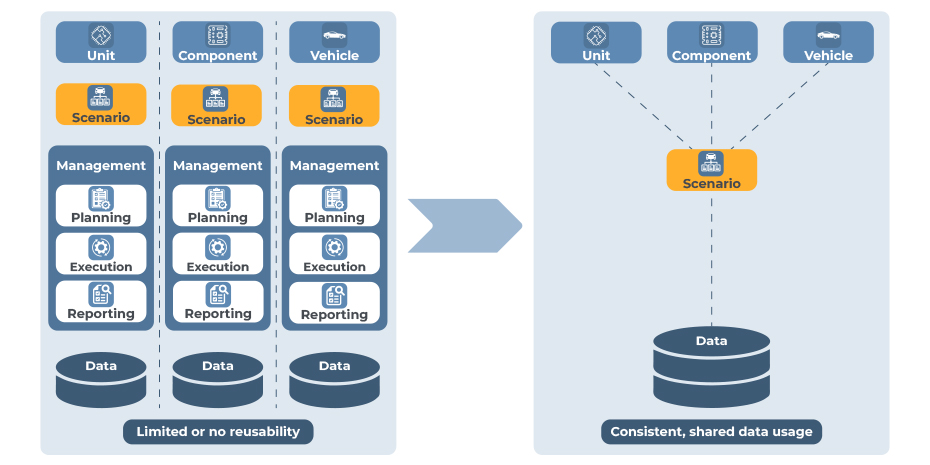
Moreover, a consistent data backbone provides full traceability throughout the development process. Test results can be reliably linked to specific software versions, configurations and environments. This is particularly critical when identifying and resolving defects, as it allows teams to trace faulty results back to their origin and take targeted corrective actions. In turn, this strengthens quality assurance and helps maintain the highest possible standards in increasingly complex automotive development projects.
The power of continuous toolchains
The third major pillar of efficient automotive development is a continuous testing toolchain. Traditionally, development ecosystems were highly fragmented, with domains such as powertrain, ADAS, vehicle dynamics and infotainment relying on separate, supplier-specific toolchains. This led to incompatible data formats, limited traceability and poor comparability of results, ultimately reducing efficiency and increasing integration effort.
Rising system complexity now demands a fundamentally different approach, in which standards are not just guidelines but core requirements that ensure consistency, interoperability and regulatory compliance across all domains. Continuous toolchains enable cross-domain collaboration and end-to-end validation by integrating simulation environments, test management platforms, automation pipelines and data analysis systems, all aligned with defined industry and organizational standards. This convergence ensures smoother handovers, greater reuse of models and test cases as well as continuous feedback loops across the entire lifecycle, turning validation into a connected and scalable process.
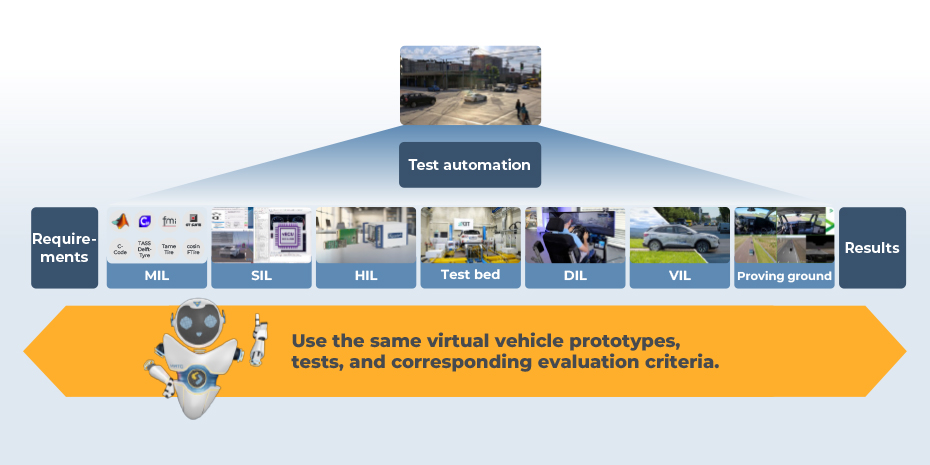
Rather than treating testing as isolated steps, leading organizations design processes that scale both horizontally across more variants and conditions, and vertically by seamlessly linking virtual and physical environments throughout all development stages. This is enabled by reusable test scenarios and virtual vehicle fleets with traceable parameters that ensure consistency across variants. In addition, interoperable models spanning all system levels support seamless integration throughout development. Automated test orchestration from MIL to VIL, combined with consistent data management, ensures efficient and reliable execution across platforms.
Conclusion
In my opinion, shift left only delivers its full potential when embedded within a cohesive and integrated development environment. Without a seamless toolchain that connects engineering disciplines, without efficiently integrated hardware-based testing that operates across domains and without consistent data flows that ensure transparency and traceability, early testing remains fragmented. To truly benefit from shift left, organizations must rethink not only when they test, but how their systems, processes and data are structured. This also requires a cultural dimension, namely the willingness to embrace change and break down existing structures.

About the author
Alexander Frings, Director Product Management at IPG Automotive
Alexander Frings is Director of Product Management at IPG Automotive, where he drives the development of hardware and software solutions for virtual vehicle development. He holds a degree in Energy and Propulsion Technology from Rheinland-Pfälzische Technische Universität Kaiserslautern-Landau and INSA Rouen Normandie. He began his career at IPG Automotive in Test Systems & Engineering and later became Product Manager for Engineering Services. From 2021 to 2024, he worked as Product Marketing Manager Software at PI Group, before taking over product management at IPG Automotive. He has authored publications on virtual prototypes, scenario generation and simulation-driven vehicle development.
Would you like to stay up to date with our blog?
Subscribe to our blog update for new and exciting articles.