
Shift left is not enough – The structural limits of hardware-centric development
May 06, 2026 | Dr. Alexander Ahlert | 5 min

Table of contents
- More testing does not increase efficiency
- The structural limits of hardware-centric development
- Shift left is a reaction, not a structural solution
- Structural fragmentation and its consequences
- Software complexity changes the rules
- From validation bottlenecks to structural continuity
- Rethinking efficiency in automotive development
- Conclusion
- Read more
- About the author
Automotive companies are testing more than ever before. They test earlier, increase the number of simulations and invest heavily in validation. However, the core issues remain the same as development timelines are not shrinking proportionally, time to market remains under pressure and warranty costs still surface too late in the lifecycle. This indicates that automotive companies do not have a testing problem, it is a structural one.
More testing does not increase efficiency
Over the past few years, organizations have significantly expanded validation activities. Through the earlier introduction of virtual test environments, simulation capacities have increased and shift left has become an industry-wide principle.
The assumption is straightforward – earlier defect detection reduces rework costs and accelerates development. And to a certain extent, it works.
But many organizations observe a paradox: Even though they shift left and reap small benefits, overall, the engineering effort continues to rise, and cross-domain coordination becomes more complex. In addition, integration phases remain bottlenecks and system-level transparency emerges too late. This is because the root of the issue lies deeper than test timing.
The structural limits of hardware-centric development
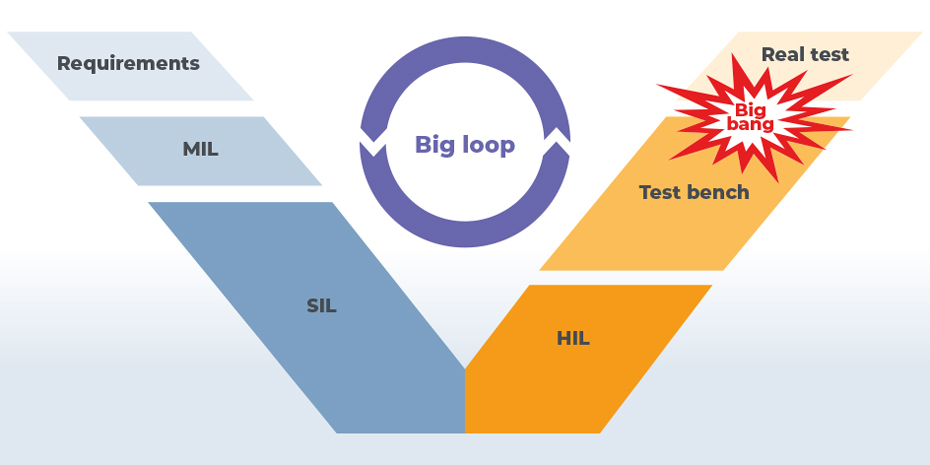
Traditional vehicle development has long been organized around hardware availability. Integration and validation were closely tied to physical prototypes and hardware-in-the-loop environments. This approach worked in a predominantly mechanical engineering context. However, it inherently created validation bottlenecks due to an event-driven rather than continuous integration process, costly and time-consuming iteration loops and the late visibility of cross-domain effects.
As vehicles become increasingly software-defined, this concept reaches its limits. Software introduces dynamic interactions across domains. Functions are no longer isolated; they are interconnected and continuously evolving. When integration depends on hardware availability, scalability becomes structurally constrained. In this case, more testing cannot compensate for an architecture designed for sequential integration.
Shift left is a reaction, not a structural solution
Shift left is often treated as a tactical optimization: test earlier, simulate sooner, detect defects upfront. But in reality, shift left is more of an architectural decision. Without continuity in vehicle development – specifically without integrated toolchains, consistent data flows and early system integration – earlier testing remains isolated.
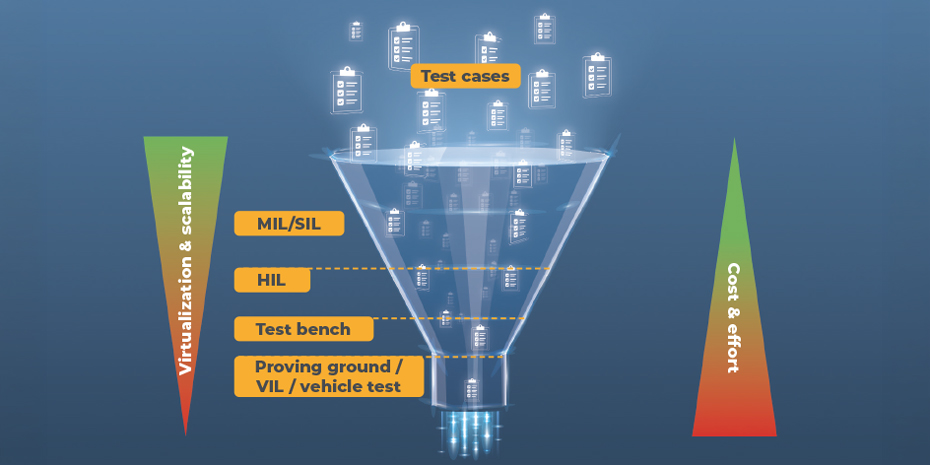
If test systems are not embedded into a coherent development architecture, organizations encounter discontinuities between tools, redundant validation efforts, limited reuse of test artifacts and fragmented data transparency. Under these conditions, shifting left may reduce local inefficiencies, but it does not eliminate structural silos. Earlier testing does not automatically lead to shorter development cycles, lower total development costs, reduced warranty exposure and higher decision confidence.
Structural fragmentation and its consequences
In many organizations, toolchains remain fragmented across domains. Integration, validation and software development teams from the fields of powertrain, vehicle dynamics or ADAS for example operate in siloed environments with limited validation alignment and continuity. Additionally, test artifacts are not fully reusable or even comparable. In these environments, integration and validation remain event-driven rather than continuous.
This results in, for example:
- Discontinuities between tools
- Redundant validation efforts
- Limited traceability across development stages
- Late transparency of maturity levels and system quality
As software complexity increases, these discontinuities multiply leading to risk-intensive and resource-heavy integration phases. The effort required to align domains grows disproportionately.
The paradox now becomes evident: organizations test more, invest more and automate more – yet overall efficiency does not improve at the same rate.
Software complexity changes the rules
Software-defined vehicles introduce a new level of systemic interdependency. Millions of lines of code interact across domains. Functions are no longer isolated; they are interconnected and dynamic. Additionally, the required scenario diversity expands significantly. In this context, validation can no longer be treated as a late-stage approval activity. It must evolve into a continuous, integrated overall system validation.
When integration and validation depend on hardware availability, scalability is structurally limited as physical prototypes cannot keep pace with software iteration cycles. Scenario-based validation on full vehicle level also remains constrained, and the late detection of systemic effects leads to costly corrective loops and increased warranty risks.
This structural overload explains why development effort, resource consumption and risk exposure continue to rise – even in organizations that have adopted shift-left practices.
From validation bottlenecks to structural continuity
If the challenge is structural, the response must also be structural. To establish continuous validation in vehicle development, different requirements need to be met. An integrated toolchain connecting modeling, simulation and testing is needed, as well as early and continuous virtual system integration. Furthermore, scenario-based validation from component to full vehicle level must be automated at scale, and consistent data flows and cross-domain traceability are required too.
With these requirements, virtual development environments are no longer supplementary tools – they become the backbone of an integrated development architecture. By enabling early system integration and validation before hardware availability, organizations can parallelize development processes, reduce physical iteration loops, increase test, scenario and use case coverage and gain earlier transparency into system risks.
So, it is not simply about testing earlier. It is about embedding validation into the development architecture itself.
Rethinking efficiency in automotive development
True efficiency in modern vehicle development does not emerge from isolated optimizations. It stems from architectural coherence.
When virtualized, holistic validation is integrated continuously along the development process rather than executed sequentially, organizations gain systemic advantages:
- Accelerated time to market
- More resource-efficient development
- Reduced warranty exposure
- Increased decision reliability
Shift left remains a necessary evolution, but without integrated, virtualized and scalable development architectures, it addresses symptoms rather than causes.
Conclusion
The transition toward software-defined vehicles exposes the structural limits of hardware-centric development. Increasing test intensity alone cannot resolve validation bottlenecks. What is required are continuous virtualized development processes and methods – across departments, domains and development phases – supported by virtual test environments and early system integration.
Shift left is necessary, but it is not enough.
Read more
For a deeper exploration of evolving test strategies and continuity in vehicle development, download the full whitepaper:

About the author
Dr. Alexander Ahlert, Lead Consultant & Branch Manager Stuttgart at IPG Automotive
Dr. Alexander Ahlert is globally responsible for consulting and business development activities at IPG Automotive. He is a recognized leader and expert for virtual development, digitalization and vehicle technology, with a particular focus on virtual development, simulation, verification and validation, and has contributed to various publications in his field. He holds engineering degrees from the Karlsruhe Institute of Technology (KIT) and earned his PhD from the University of Stuttgart, specializing in vehicle dynamics, multi-body system dynamics, control engineering, test benches as well as modeling and simulation.
Would you like to stay up to date with our blog?
Subscribe to our blog update for new and exciting articles.