
SensCompute Gen II: Scalable performance for advanced sensor simulation
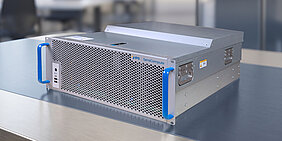
Meeting the growing demands of sensor simulation
Modern driver assistance and automated driving functions rely on increasingly complex sensor configurations. Accurately simulating camera, radar, lidar and ultrasonic sensors requires substantial computing power, particularly when several sensor models must run simultaneously.
SensCompute Gen II provides a scalable hardware solution for these demanding applications. Computationally intensive test scenarios are distributed across multiple GPUs, enabling complex sensor models to be calculated efficiently. Tailored to CarMaker, the system is delivered as a preconfigured plug-and-play solution for fast integration into development and testing environments.
Powerful support for HIL testing
SensCompute Gen II is designed for sensor computation in hardware-in-the-loop (HIL) environments. It can provide virtual sensor data and serve as a data source for injection applications, expanding the performance of new or existing test infrastructures.
With configurations of two, four or eight GPUs, the system adapts to different sensor setups and performance requirements. Individual sensors can be assigned to dedicated GPUs, allowing available computing resources to be distributed according to the application.
Low latency and seamless integration
Accurate timing is essential in sensor-based HIL applications. The RTX PRO Sync technology synchronizes GPU output signals with external clock sources to minimize latency across the test setup.
The standardized, preconfigured system is designed for straightforward integration and can be adapted to customer-specific applications. Its scalable architecture helps development teams run complex scenarios efficiently, increase test coverage and extend the capabilities of their sensor simulation environments.
Efficient resource allocation through GPU clustering
A further technical benefit is the ability to assign individual sensors to dedicated GPUs. This clustering approach distributes the computational effort across the available hardware and allows resources to be configured according to the complexity of each sensor setup. As requirements grow, additional GPU capacity can be used to support more extensive sensor configurations while maintaining an efficient calculation process. As a result, the solution can easily scale from simple sensor arrangements to highly complex simulation environments without compromising efficiency.
Do you want to discover how this hardware solution can support your business?