

Virtual testing for NCAP and ADAS homologation
Virtual testing for active safety is increasingly recognized by both Euro NCAP and regulatory frameworks as a complementary method to assess advanced driver assistance systems (ADAS), such as autonomous emergency braking and lane keeping assist. It enables authorities and assessment bodies to evaluate vehicle performance across a broad range of standardized and parameterized driving scenarios, complementing and even extending beyond what can be covered through physical testing alone. In Euro NCAP, simulation is used to support ratings by covering a much broader test matrix whilst reducing the number of physical tests. Safety system performance can thus be assessed across all variations of test scenarios, including edge cases. For regulatory homologation, virtual testing is accepted under defined conditions: validated models, controlled processes and demonstrated equivalence with physical testing are required to ensure compliance and reliability.
Euro NCAP
scenarios
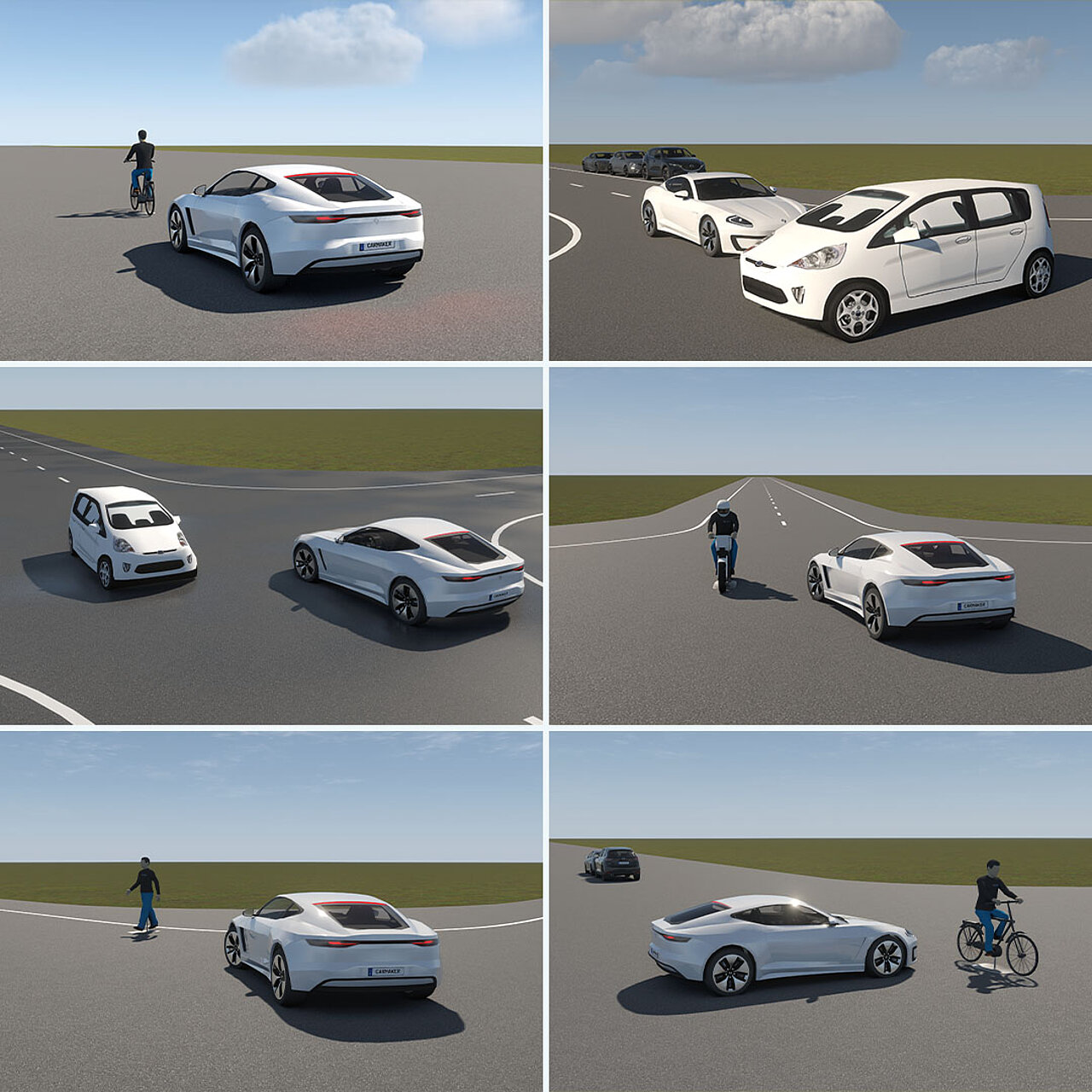
For consistent and objective safety ratings, Euro NCAP scenarios make use of simulation to complement physical vehicle testing in safety assessments, enabling a more comprehensive evaluation of ADAS performance. These standardized and parameterized scenarios include variations and edge cases that go beyond what is feasible in real-world testing, which ensures robust and repeatable system behavior. The UTAC Scoring Set Europe package includes a CarMaker setup compliant with the Euro NCAP 2026 protocol, covering scenarios, test automation, KPI calculation and post-processing. It also enables the pre-calculation of virtual Euro NCAP scores.
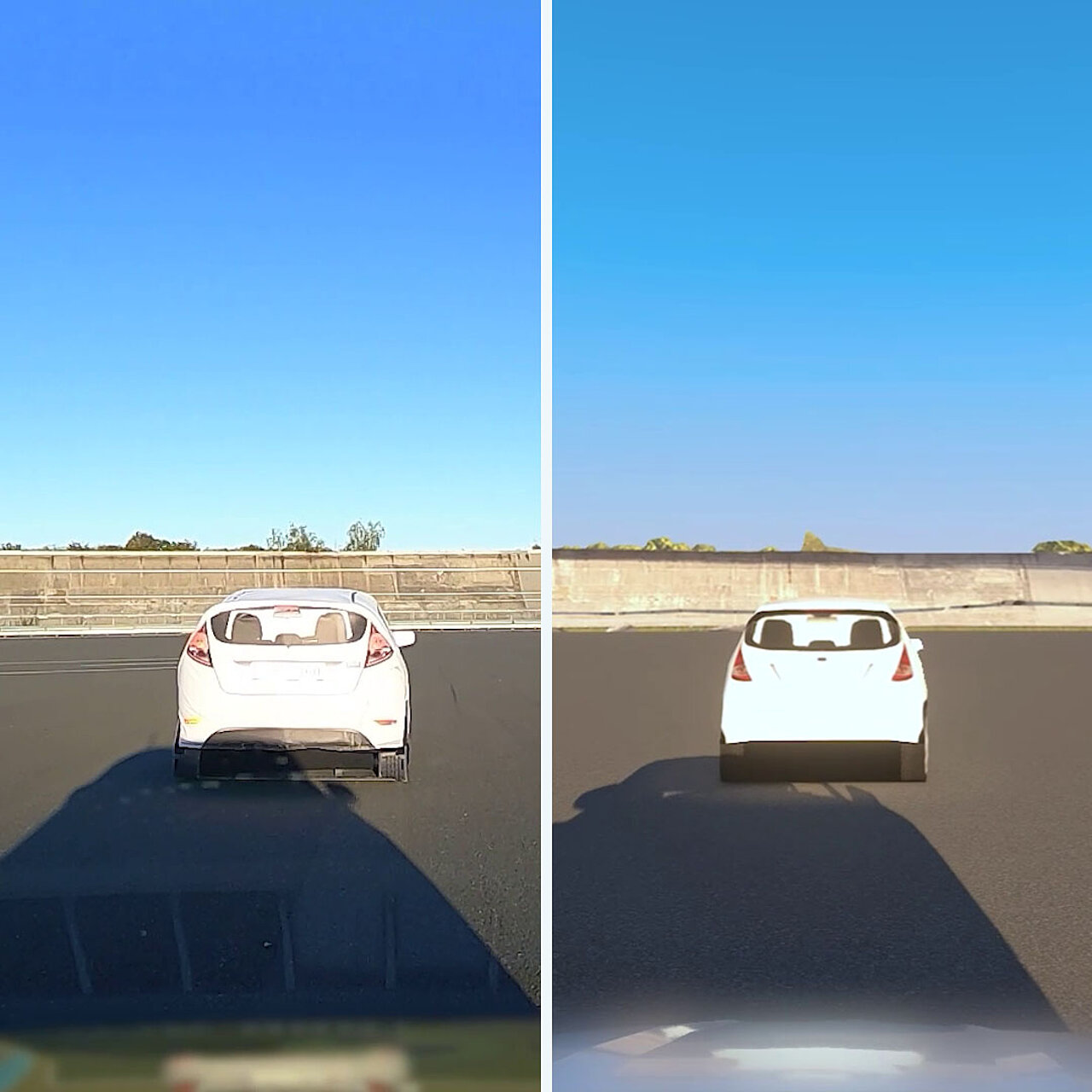
Virtual targets are digital representations of real-world targets used for testing on proving grounds. They form the basis for the accurate reproduction of scenarios in virtual test environments and support safety validation. To align with UNR and Euro NCAP reference targets, they must be standardized and ISO-conform, which also enables reproducible and scalable simulation results. The 4active NCAP Digital Twin Package provides precise 3D models with validated and ISO-conform geometry and material properties for reliable camera, lidar, radar as well as ultrasonic perception. This CarMaker add-on supports continuous simulation credibility and delivers consistent raw sensor results for virtual NCAP and UNR tests.

Virtual prototypes rely on a well-structured digital-twin generation to ensure accurate and credible simulation results. CarMaker enables the development of early-stage vehicle models, allowing ADAS functions to be tested and validated before physical prototypes are available. Thereby, the entire vehicle can be modeled virtually, and components such as the chassis, powertrain as well as a wide variety of sensors and control units, can be simulated. This approach supports rapid iterations, broad scenario coverage and reduces dependencies on costly and time-consuming physical testing. It therefore accelerates development cycles while improving overall system quality and safety.
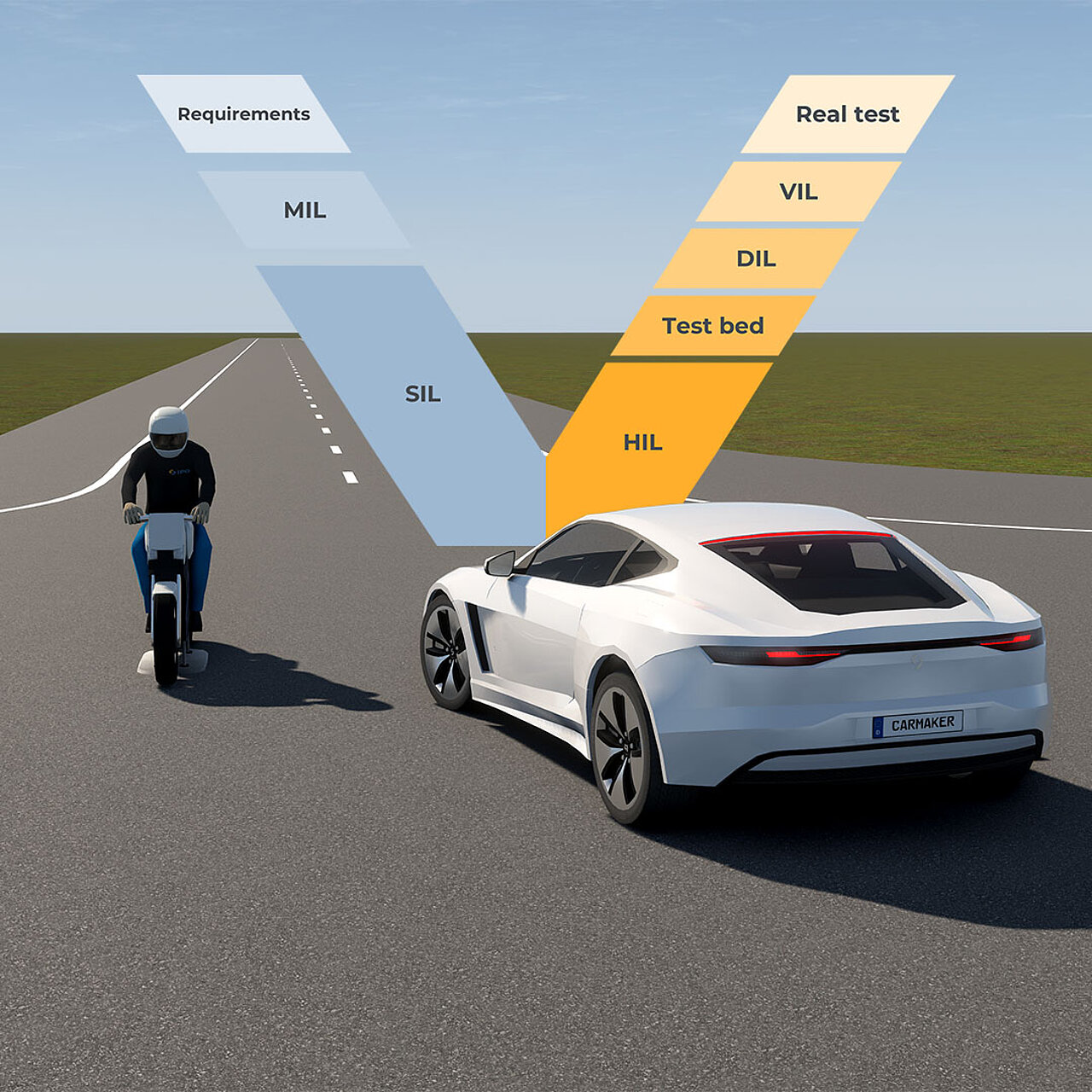
A continuous and integrated simulation process is essential to meet the increasing demands of Euro NCAP assessments and regulatory homologation, ensuring end-to-end validation, efficiency and consistency across the vehicle development lifecycle. For this, validated vehicle models, virtual targets, standardized scenarios and performance criteria aligned with NCAP and regulatory requirements are needed. The process must therefore leverage different test methods such as virtual ECUs and scalable cloud-based simulation environments as well as the support of all relevant development stages (MIL, SIL, HIL, VIL). This enables efficient and flexible validation and guarantees traceability and reproducibility. The resulting credible and auditable simulations support consistent Euro NCAP evaluations and compliance with approval authorities. Continuous virtual testing also strengthens confidence in simulation-based evidence as a key pillar for both homologation and consumer safety assessments.

Credibility assessment is a key requirement for acceptance in regulatory homologation that guarantees reliable, accurate and compliant simulation results. It is based on validated models and controlled processes with demonstrated equivalence to physical testing which also comprises verification of virtual proving grounds and reference targets. The assessment is supported by a comprehensive framework, including model and simulation management with VIRTO for traceability, verified tools such as ISO 26262–certified CarMaker with the 4active NCAP Digital Twin Package and structured processes for validation. This ensures transparent, auditable and trustworthy simulation outcomes across the development lifecycle.
Use cases
Virtual testing of Euro NCAP 2026 protocol
Automotive OEMs must provide a dossier setting out the performance of their systems, either on self-claim basis or by presenting the results of virtual testing. With the UTAC Scoring Set, engineering teams gain direct access to all relevant test scenarios, including standard and extended variations for systems such as AEB, FCW and ELK. Based on a shared ground-truth environment and standardized targets, teams ensure consistent and correlated simulation results across a significantly increased number of test variants. By integrating the validated scoring logic into their existing toolchain, developers can continuously assess system performance against Euro NCAP requirements. This enables early identification of safety gaps and targeted optimization before physical testing begins. As a result, development time is reduced, costs for real-world testing are minimized and the vehicle achieves a high crash avoidance rating with greater efficiency and confidence.

Validated and standard-compliant targets for credible simulation
When using a digital twin of a motorcycle target to validate ADAS in virtual testing environments, ISO 19206 5 is strictly applied. This is necessary to ensure that the digital representation accurately reflects the standardized geometry, material composition and structural characteristics of the physical target. Attention is given to reproducing the radar-relevant properties, including radar cross section (RCS) maps and Doppler signatures, to guarantee realistic sensor perception. The development process also integrates the measurement and validation procedures defined by the standard, ensuring that both physical and virtual targets can be compared and verified. By adhering to these specifications, the digital twin achieves a high level of fidelity and reliability for simulation-based validation. Consequently, the approach supports consistent testing outcomes in the real and virtual world, while ensuring compliance with international standards.

TECH TALK: Simulation of NCAP tests for crash avoidance
ADAS and active safety systems play an important role in vehicle assessment. In this TECH TALK episode, learn how to test these systems in simulation, achieve robust and reproducible results, and efficiently automate and evaluate complex test protocols.