
IPG Automotive Wins AWS Hackathon with Agentic AI Workflow
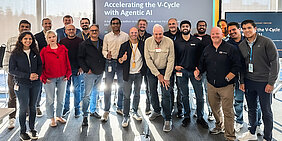
David Howarth (8th from the right), Aniket Lele (6th from the right) and Giri Aigalikar (5th from the right) from IPG Automotive USA together with representatives from AWS and HERE Technologies Image: Amazon Web Services, Inc.
IPG Automotive won first place at the Santa Clara AWS Hackathon with its solution “Accelerating the V-Cycle with Agentic AI.” The team demonstrated how AI agents can support a closed-loop software development lifecycle for software-defined vehicles. Using AWS Kiro, it created an end-to-end workflow in less than a day that connected requirements management, software modification, testing and system-level validation.
The project addresses a structural bottleneck in automotive systems engineering: requirements and testing omissions are often discovered late, while diagnosing and resolving functional gaps across siloed engineering disciplines can take weeks or months.
AWS Kiro was utilized to orchestrate a recursive, multi-agent development loop for a driving scenario in which vehicle dynamics determine feature performance. Vehicle data from a recorded real-world event revealed an Adaptive Cruise Control (ACC) Key Performance Indicator (KPI) failure, triggering an automated remediation process completed within hours:
Dynamic root-cause analysis: The multi-agent system compares the reported KPI failure with baseline requirements, identifies gaps and generates new functional requirements where needed.
Automated code and test generation: The agentic workflow refactors the ACC C code and generates test scenarios based on the updated requirements.
Agent-based software testing and debugging: On AWS Graviton instances, the modified ARM-based ACC software undergoes continuous verification and debugging loops, including C code static analysis and unit testing.
Full-vehicle system-level validation: The ACC software is integrated into a virtual vehicle prototype in CarMaker and validated through virtual test drives using the generated test scenarios in the context of full-vehicle dynamics.
V-cycle and audit traceability: After verification, the system generates compliance dashboards and engineering reports, ensuring traceability across the V-cycle.
The demonstration highlighted the potential of agentic AI to shorten selected analysis and remediation loops from several weeks to a few hours. The approach can also be transferred to other advanced driver assistance and automated driving functions as well as infotainment systems.
"Building an autonomous, multi-agent SDLC workflow from scratch in under a day highlighted the speed and orchestration capabilities of AWS Kiro,” said David Howarth, Director Global Sales Strategy at IPG Automotive USA. “Equally exciting was how seamlessly CarMaker integrated into the agentic workflow via its Model Context Protocol (MCP) server. Using the complete system to enable AI agents to directly evaluate requirements, run traditional software tests, and execute virtual test drives in the cloud, we demonstrated that closing the loop between requirements and system-level validation doesn’t have to take months – it can happen in hours."