
How to turn real-world vehicle data into reusable development and validation assets
October 30, 2026 | Daniel Zalghout | 4 min
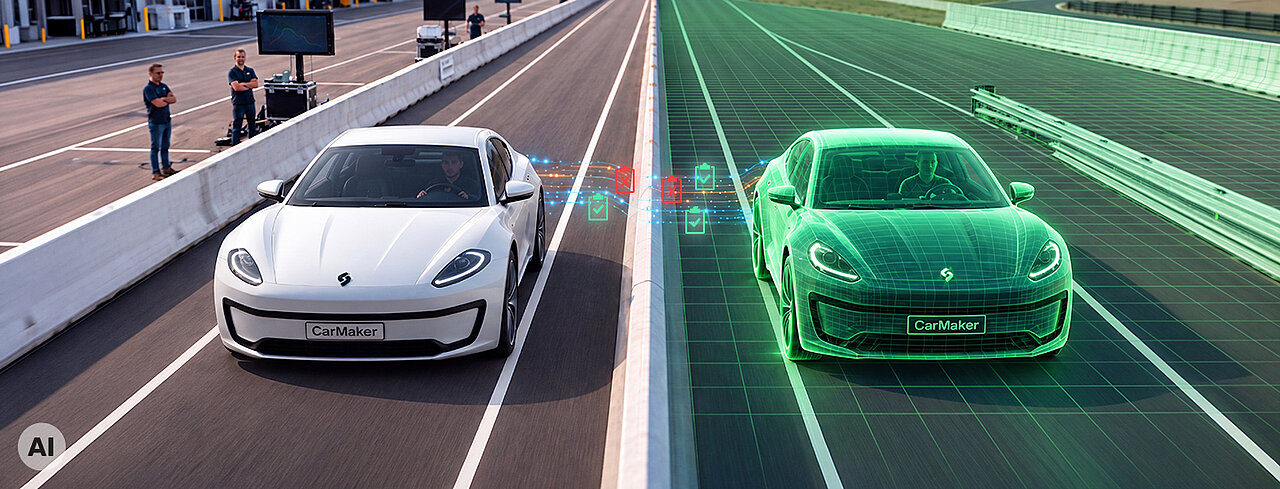
For years, the automotive industry worked under the premise that logging the most test kilometers guaranteed the lead in automated mobility. Today, engineering organizations maintain massive servers filled with recorded test drives, yet validation bottlenecks persist. The root cause is apparent: The industry does not suffer from a lack of data; it suffers from a lack of reusable validation assets.
Most of the time, recordings from test fleets are only treated as one-off test evidence. A test run is logged to document a road trial or investigate an isolated anomaly and then archived in a data server where it is never touched again. Meanwhile, development teams struggle to locate important edge cases inside raw recordings, manage consistent metadata, prepare clean datasets for AI and reproduce anomalies deterministically in the lab.
Overcoming this bottleneck requires a strategic shift: Real-world data should not be treated as test evidence only. It should become a reusable asset for AI training, scenario generation, replay, simulation and validation throughout the entire development lifecycle.
Why is the problem particularly pressing in ADAS and automated driving?
The complexity of modern vehicle systems is expanding much faster than physical testing can accommodate. Next-generation ADAS and automated driving architectures integrate a package of sensors, complex control logic and perception models.
Traditional test driving strategies cannot be scaled to meet these demands. The real world contains a near-infinite combination of road layouts, weather conditions and traffic interactions. When a perception model is retrained or a motion planner is updated, physically trying to obtain identical conditions to verify performance is impossible. Without a systematic way to convert real-world vehicle data into accessible, reusable assets for virtual validation, development teams face expanding debugging cycles, fragmented toolchains and critical gaps in safety coverage.
Putting data-driven development into the right context
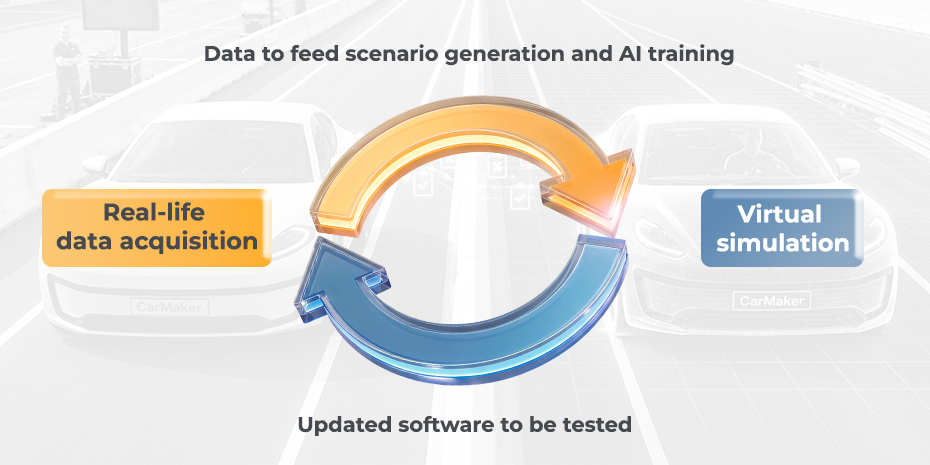
Data-driven development is not about expanding cloud storage. It is about establishing a deterministic pipeline that bridges real-world vehicle operation and virtual development. In reality, this requires combining two essential standard testing methods:
- Open-loop testing (replay and debugging): Recorded sensor and bus streams are reinjected into software or physical ECUs in their original timeline. This enables immediate reproducibility, allowing engineers to isolate root causes and debug software in the lab.
- Closed-loop testing (scenario-based simulation): Open-loop replay reaches its limit once the system under test acts differently than in the original recording, examples being earlier braking or steering away. Because a static log cannot adapt to a new trajectory, testing must shift to dynamic simulation. Converting the event into a virtual scenario with virtual vehicle prototypes and sensor models allows the system to interact with its environment and get the proper feedback from it.
Connecting both standard methods enables a seamless switch between replay and scenario-based testing, which eliminates toolchain fragmentation across the validation cycle.
The end-to-end workflow
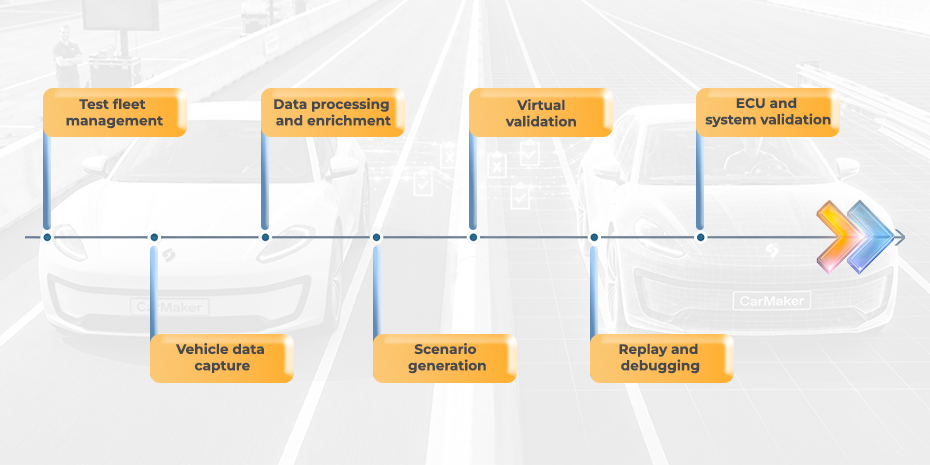
Transforming raw road data into scalable validation assets relies on an integrated four-stage process chain:
- Capture: The process begins with fleet-wide test campaign management and high-bandwidth vehicle and sensor data acquisition. Time-synchronized logging across vehicle buses, production sensors and reference instrumentation guarantees high-fidelity ground truth without signal loss or timing drift.
- Enrich: Raw binary files offer limited value without structure. Automated data processing and quality assurance verify signal integrity and filter corrupted runs. Automated annotation and structured metadata management then classify scenes by maneuver, road type and object interactions, creating searchable datasets for AI training.
- Virtualize: Scenario extraction algorithms convert recorded trajectories and environmental conditions into realistic virtual scenarios. Combined with virtual vehicle prototypes and sensor models, teams generate synthetic datasets to close coverage gaps rarely encountered during physical fleet testing.
- Validate: Reusable assets are deployed across software-in-the-loop (SIL), hardware-in-the-loop (HIL) and full ECU validation. Injecting sensor and bus data into virtual models and physical hardware enables reproducible testing at every development stage.
From real-world problems to reusable test cases
Consider how this workflow resolves a real-world edge case: A fleet vehicle experiences an unexpected phantom braking event near a highway construction zone in heavy rain. In a disconnected workflow, diagnosing the issue requires days of manual log searches, followed by inconclusive attempts to recreate the event on public roads. However, in an integrated pipeline, that single anomaly becomes an important asset:
- Immediate reproduction: Enriched metadata pinpoints the recording, allowing engineers to replay the sequence via open-loop injection to rapidly debug perception logic.
- Scenario variation: The road layout and traffic trajectories are converted into a virtual scenario. By varying rain intensity, vehicle spacing and lighting, teams generate synthetic data to retrain models and verify control robustness in closed loop.
- Regression validation: The scenario is integrated into automated SIL and HIL test pipelines, securing regression coverage across future software releases without requiring additional test drives.
Most importantly, this architecture integrates into existing validation environments without replacing prior infrastructure investments.
Strategic outlook
As automated driving systems mature and regulatory demands tighten, the economics of automotive engineering are definitely shifting. The competitive advantage will no longer be who collects the most data, but rather who can convert data most efficiently into development and validation knowledge.
Bridging physical logging and virtual simulation unlocks critical engineering velocity. By unifying fleet management, high-bandwidth capture, automated enrichment and closed-loop simulation into an end-to-end pipeline, organizations scale validation efficiently while reducing debugging effort. Ultimately, data-driven development creates a continuous feedback loop between real-world operation, AI training, virtual validation and system testing.

About the author
Daniel Zalghout, Application Engineer at IPG Automotive
Daniel Zalghout is an Application Engineer at IPG Automotive with a background in hardware-in-the-loop testing, simulation and software validation. Before joining IPG Automotive France in 2024, he worked as a Simulation Engineer at FEV Software and Testing Solutions and as a Senior Software Validation Engineer for Alpine Formula E and Formula 1. He holds a master’s degree in Powertrain Engineering from IFP School, where he focused on electric vehicles, simulation and modeling, as well as a bachelor’s degree in Mechanical Engineering from Lebanese American University.
Would you like to stay up to date with our blog?
Subscribe to our blog update for new and exciting articles.