
Continuous validation from model to road
The automotive industry is undergoing a profound transformation. Software-defined vehicles, increasingly complex ADAS functions and shorter development cycles are fundamentally changing how vehicle systems are engineered, tested and released.
While development processes have evolved, validation often remains fragmented. Many organizations still rely on separate workflows, tools and assets for different validation stages. Models are recreated, scenarios are rebuilt and test environments are reconfigured again and again as projects progress from virtual development to physical testing. The consequences are familiar: unnecessary engineering effort, slower feedback loops and increased risk of costly late-stage issues.
The challenge is no longer simply validating systems. The challenge is to validate them continuously.
Beyond individual test stages
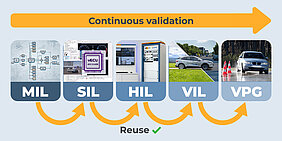
Model-in-the-loop (MIL), software-in-the-loop (SIL), hardware-in-the-loop (HIL), vehicle-in-the-loop (VIL) and proving ground tests all play an important role in modern validation strategies. Each method contributes unique insights and helps identify issues at different stages of development.
However, the greatest value does not come from the individual validation methods – it comes from the ability to connect them. When models, scenarios and test workflows can be reused throughout the entire development process, validation transforms from a collection of isolated activities into a continuous engineering workflow. Instead of rebuilding assets at every stage, teams can build on previous work, preserving knowledge, improving consistency and accelerating development.
Shifting validation earlier
One of the most significant benefits of continuous validation is the ability to identify issues earlier. Development teams can evaluate control strategies during MIL simulations, validate production software in SIL environments and verify ECU behavior during HIL testing before costly vehicle testing takes place.
Earlier feedback means that defects are discovered when they are easier, faster and less costly to resolve. As a result, organizations can reduce rework while increasing confidence in every development milestone.
Connecting virtual and physical validation
Virtual testing has become an essential part of modern vehicle development, but physical validation remains indispensable. The real opportunity lies in bringing both worlds together. When validated virtual scenarios can be transferred seamlessly into VIL environments and eventually to the proving ground, development teams gain a consistent and traceable validation process from simulation to reality.
This continuity improves repeatability, increases efficiency and creates comparable, traceable validation results across virtual and physical testing. Engineers spend less time recreating tests and more time generating meaningful insights.
Create once, reuse everywhere
At its core, continuous validation is about continuity of models, scenarios and workflows. But continuity also means that results remain transparent and comparable throughout the validation process. Decisions can be traced back to the original model, scenario and test setup, creating a consistent foundation for development, validation and sign-off activities.
By leveraging a single simulation environment throughout multiple validation stages, organizations establish a connected validation strategy that supports faster development cycles, improved test coverage and more efficient use of engineering resources. As software-defined vehicles continue to increase in complexity, the ability to connect validation activities across the entire lifecycle will become a key competitive advantage.
The future of vehicle development will not be defined by individual validation stages. It will be defined by how seamlessly they work together.