
Euro NCAP 2026 – Digital twins become the key asset
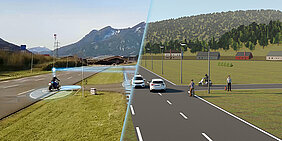
Together with 4activeSystems, we offer precise transfer of physical targets into certifiable digital twins for the CarMaker product family.
With the Euro NCAP 2026 protocol, the requirements for evaluating ADAS and automated driving functions are getting significantly stricter. A greater variety of scenarios, more refined evaluation logics and higher expectations regarding system robustness demand far more comprehensive and systematic testing. Physical tests remain the gold standard, not least from a regulatory perspective. At the same time, however, it is clear that without scalable, reproducible and reliable simulation, the increased testing effort can hardly be managed efficiently.
Simulation as an integral part of modern validation strategies
Simulation is thus evolving from a supporting tool to a key element of modern validation. It enables early evaluation of system behavior, systematic variation of parameters and targeted analysis of boundary and failure scenarios, far beyond the practical scope of physical test campaigns. However, a high degree of correlation between reality and the virtual world in needed. Especially for safety-critical test objects such as Euro NCAP targets, the quality of the underlying models determines the validity of the simulation.
Validated digital twins as a bridge between the real and virtual world
This is where our collaboration with 4activeSystems comes in: The aim is to provide validated and certifiable digital twins of Euro NCAP targets for the CarMaker product family. They are based on real measurement data from a defined measurement campaign, which are systematically evaluated and converted into technically sound, realistic simulation models. Not only do these digital twins accurately represent the geometry, but they also model sensor-relevant material properties in a stable, reproducible and consistent way across various scenarios.
Greater efficiency and reliable planning for OEMs and suppliers
OEMs and suppliers thus have a seamless data foundation spanning from real-world measurement to virtual validation. Confidence in simulation models is increased, and the validity of virtual tests is strengthened. At the same time, validation processes become more efficient, development times are shortened and regulatory requirements under Euro NCAP 2026 are met early on. Only when physical testing and simulation are closely integrated, well-founded and reliable conclusions can be drawn about the performance of modern ADAS and AV functions. This precisely is the key to future-proof development processes.