
No seasons, no limits: Rethink how vehicles are validated
September 30, 2026 | Felix Pfister | 4 min
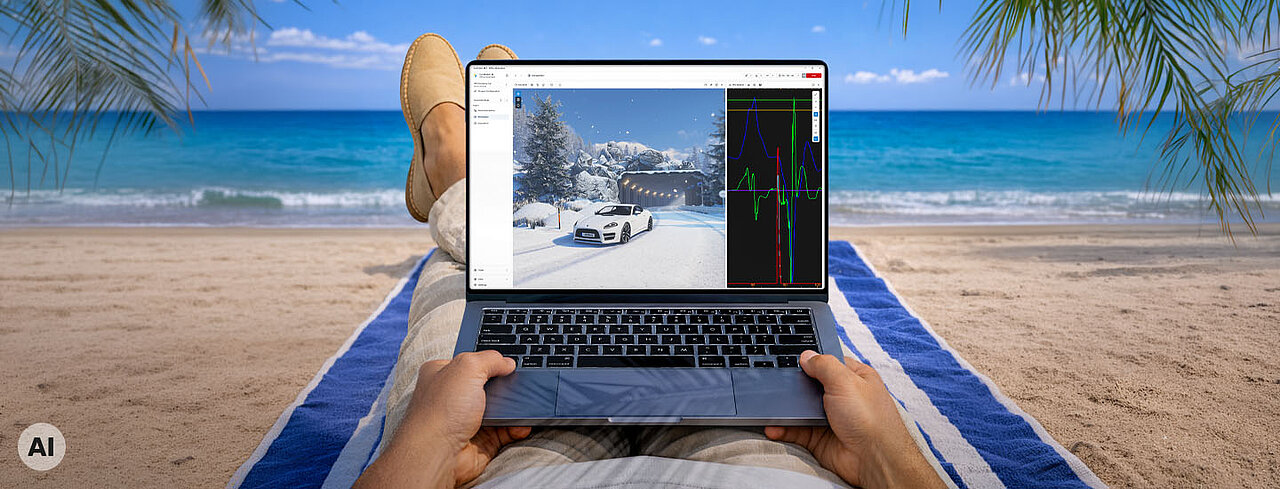
Vehicle development is changing faster than traditional validation approaches can keep up. Software updates, increasing system complexity and growing numbers of variants are expanding the validation workload, while physical testing remains dependent on prototype availability, test-track capacity, weather and location.
Although physical testing remains essential, every test needs to provide more engineering insight at an earlier stage in the validation process. This is where a virtual approach to endurance testing can offer support. This article therefore puts an emphasis on the larger opportunity of virtualization, reproducing the conditions that create the vehicle load in the first place: road, traffic and driver.
Validation without the limits of time and location
Many relevant driving scenarios are difficult to access on demand. Winter testing requires the right season and location, while specific road conditions or demanding scenarios may only be available at certain proving grounds.
Virtual test driving changes this equation. Roads, traffic, weather and vehicle behavior can be represented in a controlled virtual environment. Scenarios can be recreated when needed and under defined conditions, making different vehicle variants, calibrations or software versions directly comparable.
Controlled reproducibility also makes it easier to understand why a system behaves differently after a change. With this approach, the test conditions remain the same while the vehicle or software evolves.
From individual scenarios to scalable validation
The number of possible validation targets is growing as well. Different powertrain, software, market and equipment combinations create a range of conditions that physical testing alone cannot cover efficiently.
Virtual environments enable parameterization and systematic variation of scenarios. Large numbers of combinations can be screened before the most relevant cases are tested with real hardware on test systems or in the complete vehicle on the proving ground.
Simulation therefore has more in store than simply replacing certain physical tests. It can be used to explore different conditions, identify relevant cases and provide early feedback while development is still progressing.
As software, calibration and system configurations evolve continuously, validation feedback has an expiry date. A test result that arrives after the next software release has lost much of its value. Validation feedback has to arrive at a time when development teams can still act on it.
Endurance testing: Reproducing what causes the load
Reproducing real-world vehicle usage is one of the key challenges in endurance testing. A real-world test drive is shaped by more than the road itself. Traffic, the behavior of vehicles ahead and the driver all influence how the vehicle accelerates, brakes and responds to its environment.
The same principle applies when real-world driving is transferred into a virtual endurance environment. Simply replaying a recorded speed profile reproduces the measured history, but not necessarily the conditions that created it. If vehicle calibration changes, for example, the same fixed speed profile may no longer represent how the vehicle would actually behave in traffic.
A more representative approach is to create a digital twin of the driving context itself, including the road, the driver and the surrounding traffic.
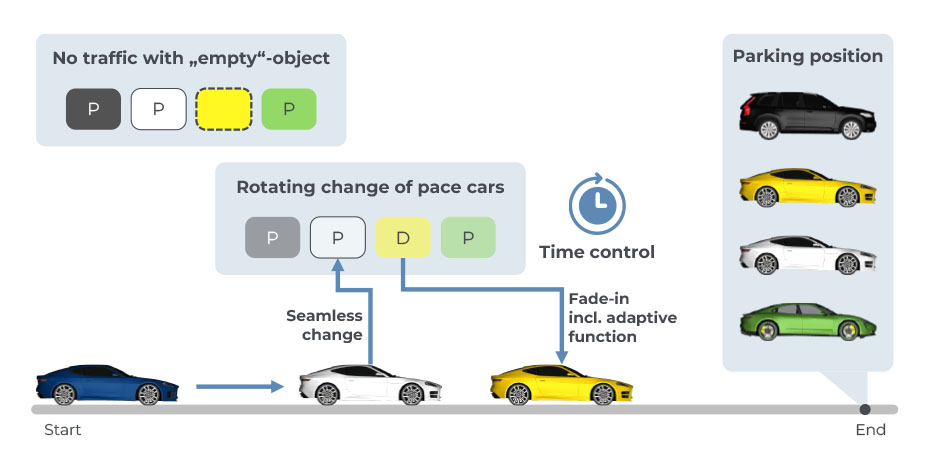
This is where dynamic traffic population comes in. Instead of using a single fixed vehicle ahead, a population of virtual drivers with different driving styles and levels of aggressiveness is introduced into the simulation. These vehicles rotate in front of the ego vehicle during the test campaign, with controlled transitions to avoid artificial discontinuities. The leading vehicle follows a velocity-distance profile derived from real measurements or simulation, including effects such as stop-and-go traffic and congestion.
When the vehicle calibration changes, the vehicle is no longer forced to follow an unchanged, predefined speed history. Vehicle behavior then emerges from the interaction between road, traffic and driver – much as it does in real-world driving.
Representativeness then becomes measurable. Distributions related to the simulated speed and distance to the pace car can be compared with measurements from the real target market, for example using the Hellinger distance: 0 means identical distributions, 1 means no overlap. When these distributions converge, there is measurable evidence that the generated driving conditions represent the relevant real-world usage profile.
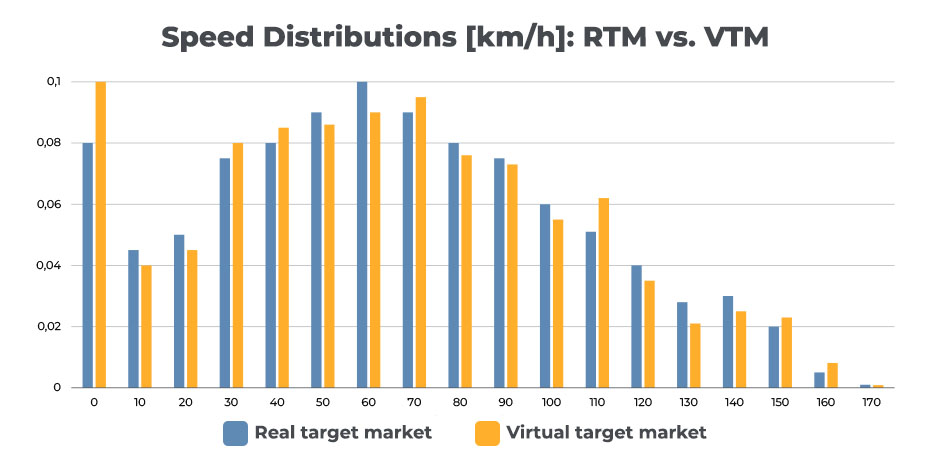
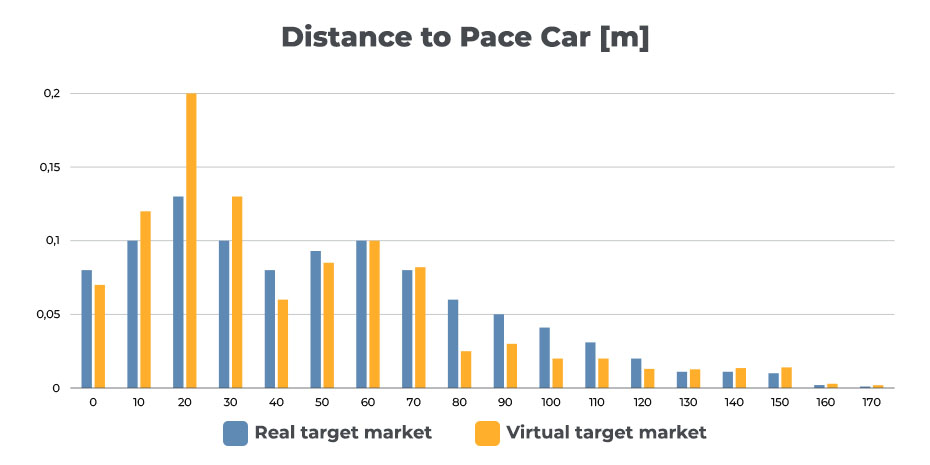
Once this foundation has been established, the virtual driving environment can be connected to real hardware on an endurance test bench. Relevant road sections and traffic situations can be reproduced repeatedly, while the hardware is exposed to representative operating conditions around the clock. For endurance testing, this creates another opportunity: The test campaign itself can be condensed. Kilometers with little damage contribution can be compressed, while damage-relevant conditions can be repeated – provided that the resulting load spectrum remains damage-equivalent to the target market.
The driving scenario remains the common reference. The same road, traffic and driver context can be used in simulation, on the test bench and finally in the vehicle. Virtualization helps reproduce these conditions whenever they are needed.
One scenario, three levels of evidence
Virtual testing also changes when validation can begin. Vehicle models, scenarios and software can be evaluated before physical hardware is available, while the same test scenarios can later be transferred to hardware-based and real-world testing. This allows users to identify issues earlier and to continuously build test coverage as the system matures.
The same scenario is first used virtually, then with real hardware on the test bench and finally in the complete vehicle on the road.
Conclusion
The objective is not simply to run more tests. It is to shorten the learning cycle: reproduce relevant driving conditions earlier, move them consistently between simulation, test bench and road, and generate validation feedback in time for development teams.
No seasons. No limits. Learn faster than the vehicle changes.
Find out more
The underlying method is described in our EuroBrake 2025 paper “Brake System Durability Testing Using Virtual Test Markets: A New Approach to Simulate Mission-Related Usage Variabilities” (https://link.springer.com/chapter/10.1007/978-3-032-10688-9_5). IPG Automotive implements it in CarMaker.
For questions on your application, contact us directly.

About the author
Felix Pfister, Lead Business Development Engineer at IPG Automotive
Felix Pfister is Lead Business Development Manager at IPG Automotive, where he works at the intersection of vehicle development, simulation and business strategy. He has a strong background in mathematics, physics and theoretical mechanics, and he still enjoys a good equation. His main focus lies on the integration of test benches into the virtual world, combining technical depth with a clear view of customer value. Today, he helps customers introduce virtual engineering and testing into their development processes to shorten development cycles and manage the growing complexity of modern mobility systems.
Would you like to stay up to date with our blog?
Subscribe to our blog update for new and exciting articles.
Subscribe now